

What is solar panel frame size?
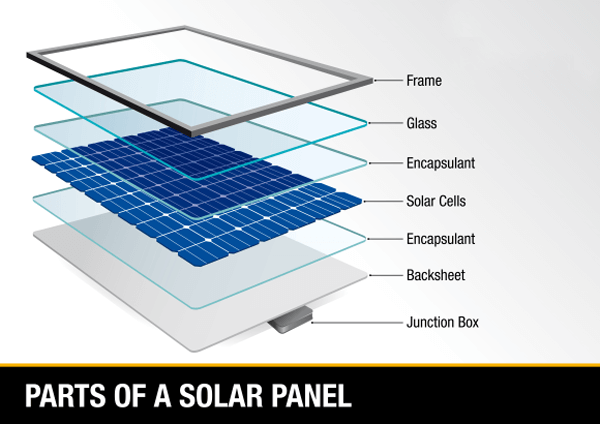
From the solar panel material list, we can find that the solar panel frame size equals the solar panel size, so we would like to talk more about the solar panel size. Firstly, I would like to discuss the average solar panel.
Average solar panel and solar panel frame size
Solar panels come in all kinds of shapes and sizes these days. However, most of the common panels used in today’s residential and commercial installations come in two standard sizes, which are broken down into 60-cell and 72-cell solar panels.
Each solar cell is roughly six inches by six inches, depending on the PV module manufacturer.
A 60-cell panel is made by laying out 10 rows of six solar cells. So, there are six cells across (width) and 10 cells down (height). If each cell is a six-inch square, then the width will be approximately 36 inches wide (6×6) and 60 inches tall (6×10).
Average Solar Panels Dimensions
Commercial – 72 cell – 3.25 (39 inches) ft X 6.5 (77 inches) ft
Residential – 60 cell – 3.25 (39 inches) ft X 5.5 (66 inches) ft
However, 72-cell count panels are made six cells wide by 12 cells tall, making them just as wide as 60-cell panels, but about a foot taller. Commercial projects commonly use 72 cell count panels, while most residential projects use 60 cell panels.
Please bear in mind that these numbers are mere averages. Each manufacturer may vary slightly by an inch or two due to using different framing materials.
Difference between Residential and Commercial solar panels
Although the underlying technology and system structure are pretty much the same everywhere, the panel sizes may vary based on the available installation space. Residential systems, typically rooftop systems, usually require a few hundred square feet. They also require due consideration of the roof’s ability to carry weight.
As such, residential systems usually employ slightly smaller panels as compared to a commercial system. But exactly how big are solar panels that are employed for residential spaces? Usually these are 65 inches by 39 inches, or 5.4 feet by 3.25 feet. Speaking of commercial systems that have a comparatively much larger number of panels, the size is normally 77 by 39 inches, or 6.4 feet by 3.25 feet. The depth of a solar panel may be anywhere between 1 and 2 inches, and depends mainly on the frame thickness.
You may have noticed that in both cases, the width remains the same. This factor is governed by the way solar cells are placed inside a panel. Generally, there are six columns of cells for both cases. For the smaller panels, there are 10 rows along the length, making 60 cells in one panel. For the larger one, there are 12 rows, making it 72 cells per panel.
When going for rooftop systems, an important thing to consider is the weight of the solar panel. With all of the glass, frame, and laminating sheets contributing, the average weight of a solar panel is 40-50 pounds depending on size. Alternatively, it can also be said that panels weigh 2-4 pounds per square foot.
Besides the length and width, the word ‘size’ may mean different things to different people. Especially for people working in the solar industry, panel size usually refers to the maximum power a panel can generate. This is measured in Wp (Watt peak – Watts generated in standard or ideal conditions). For instance, a 77 x 39 panel may have a power rating of 320 Wp.
Other solar panel frame sizes
Although the average solar panel is 60 cell and 72 cell solar modules, solar panel factory also manufactures other types of solar panels from 5W to 500W for different uses. We also make the solar frame size list below for your review as below:
| Power (w) | Number of cells(pcs) | Size of cells(mm) | Solar panel frame size(mm) | Weight (Kg) |
| 5 | 2*18 | 78*12 | 280x190x17 | 0.7 |
| 10 | 4*9 | 52*31.2 | 250x350x17 | 1.2 |
| 20 | 4*9 | 78*39 | 420x360x17 | 2.3 |
| 30 | 2*18 | 156*26 | 360x550x20 | 2.5 |
| 40 | 4*9 | 156*39 | 670*420x25 | 3.2 |
| 50-60 | 4*9 | 156*52 | 540x670x25 | 4.2 |
| 80-90 | 4*9 | 156*78 | 780x670x30 | 6.6 |
| 100 | 4*9 | 156*104 | 1000x670x30 | 8 |
| 110-120 | 4*18 | 156*52 | 1020x670x35 | 8.8 |
| 130 | 4*9 | 156*117 | 1120*670*35 | 10.5 |
| 140 | 4*9 | 156*63 | 1200*670*35 | 10.5 |
| 150-180 | 4*9 | 156.75*156.75 | 1480x670x35 | 12 |
| 190-200 | 6*12 | 125*125 | 1580x808x35 | 15.5 |
| 210-230 | 6*8 | 156.75*156.75 | 1320x992x35 | 17 |
| 250-270 | 6*9 | 156.75*156.75 | 1482x992x40 | 18 |
| 280-310 | 6*10 | 156.75*156.75 | 1640x992x40 | 18 |
| 340-380 | 6*12 | 156.75*156.75 | 1956x992x40 | 23 |
| 460-500 | 8*12 | 156.75*156.75 | 1956x1310x45 | 29 |
We are the best solar panel frame size manufacturers in China, if you are in need of solar frames, feel free to contact us to get the best service and product. You can also fill out the form as below, and will get the prompt reply.

Solar panel frame size and price
The Shift to Large-Format Standard Sizes (2024-2026 Industry Reality)
The global photovoltaic market between 2024 and 2026 has officially transitioned away from the older 158.75 mm and 166 mm cell dimensions of the early 2020s. Today, the supply chain is thoroughly dominated by large-format M10 (182mm) and G12 (210mm) silicon wafers. Because these massive modules carry a significantly larger surface area, the dynamic mechanical loads (wind and snow pressure) on the panel structure have increased exponentially.
This wafer revolution has forced a structural redesign of global mounting hardware. While older, smaller modules could rely on ultra-thin 30mm or even 25mm profiles, modern commercial and utility-scale solar asset protection dictates rigorous dimensional compliance:
The Irreplaceable 35mm Solar Frame Standard: To support the structural weight of 182mm/210mm single or double-glass layouts, the premium 35mm solar frame has become the absolute global engineering baseline. Precision-extruded with optimized wall cavities, a 35mm depth provides the necessary section modulus to prevent catastrophic cell micro-cracking and twisting under extreme structural wind loads.
Dimensional Vulnerability of Alternatives: Interestingly, the physical limitations of the newly introduced polymer-based PU composite frame become apparent in these large-format sizes. Due to the lower elastic modulus of composite plastics compared to high-grade aluminum alloys, a PU composite frame requires a much thicker profile design to achieve equivalent stiffness, often adding unwanted dead weight and dimensional complexities to global racking and tracker clamps.
For advanced building installations, such as modern BIPV layouts requiring specialized double-glass solar frame profiles or custom infrastructure including the BIPV solar panel frame top rail, sticking to certified, high-tolerance aluminum size matrices remains the safest mechanism to ensure full compatibility with international engineering building codes.
Recent Posts
- Is aluminum good for solar panels?
- Non-metallic frame for solar modules is coming
- What are the applications of BIPV solar panels
- The next generation solar energy in 21st century
- First Solar signs definitive agreement to sell US development platform to Leeward
- Thailand to get world’s largest hydro-floating solar project
- What are 5 disadvantages of solar energy in 2026?
- What are 5 Advantages of Solar Energy? (2024-2026 Latest Updates)
- 5+ Free Solar Panel Frame Design Service
- What material is used in frame of solar panel?