
Basically, scientists try to explain nature phenomenon by patterns that can be repeated in many cases. Science explains the quality of a phenomenon and answers the first curious mind’s question, such as (how?), and then the quantity of a phenomenon by answering the second question, such as (how much?). Therefore, scientific models through theories could be helpful because they can explain nature phenomenon repeatedly, like urban rules, and they are valuable as long as they work.
There are three major scales in science that scientists are dealing with. Huge, such as stars; ordinary, as common life; and tiny, as atoms. Unfortunately, there is not a unique theory for explaining all of the scales (however, they are related in many ways); then there are different theories in different scales. Now, tiny or atomic scale time.
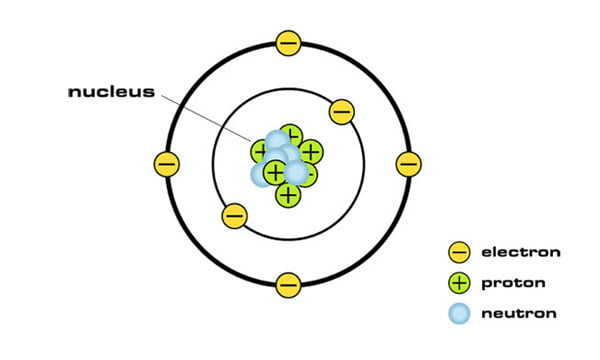
Democritus in ancient times described the smallest portion of matter as an atom, and he thought it was a unit of matter like a brick as a unit of building, but more investigations in recent centuries showed something should be inside the unit, and then scientists tried to understand Atom system. In words, they understood the atom is a system where some particles inside are working together!
Finally, they named the major particles as the electron, the proton, and the neutron. On the other hand, they found out Electron has negative and Proton has positive charge. So you should know how an idea of how does solar panels work.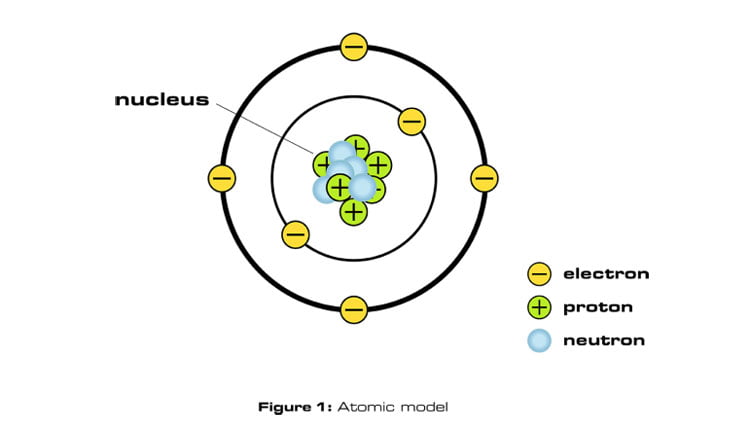
Electrons turn around the nucleus at certain distances that are called levels, and Protons and neutrons are located in the center of the Atom. Now, the number of levels in an Atom of a specific element, plus the number of Electrons on its last level, could be the element ID. This is a basic rule of the arrangement of major elements arrangement in periodic table (columns 1-2 and 13-18).

Therefore, rows show levels, and columns in major elements show the number of electrons in the last level. As an example, Si has 3 levels (2,8,4) and 4 Electrons at the last level.

Then, at column number 18, the maximum number of Electrons at the last level could be 8. Elements with fewer than 4 Electrons on the last level are conductors, like metals, and more than 4 are insulators. Then, elements with 4 Electrons at the last level should be semiconductors.
Now, there is a question. If Electrons in an Atom located specifically, is manipulation possible?
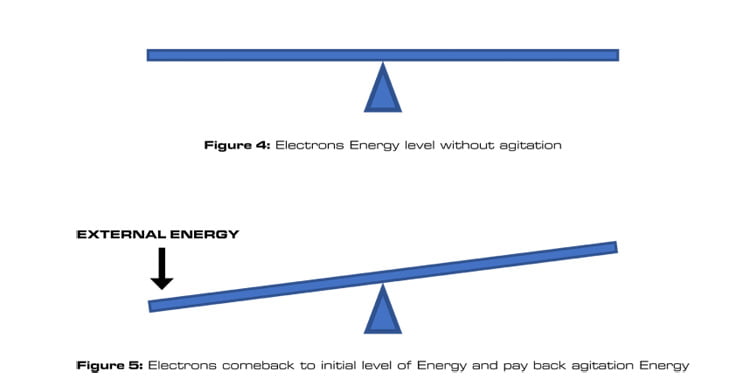
The answer is positive, but there should be an external Energy source like heat, light, or others. Then, last level Electrons can get energy and make more distance from nucleolus.
Second question. Can we achieve Energy by manipulation like a power plant?
The answer is positive, as expected in solar cells. When Electrons are stimulated by an external source of energy, such as light, heat, or misc. Electrons go further, but when the source is removed, refer to the Energy Conservation Law (Energy is fixed in the world. In words, it is not created or it is not destroyed. Only it can be converted to the types of Energy as Electricity, Magnetism, Heat …) Electrons pay back all Energy they achieved and go back to initial level.
In short, electrons’ agitation by a light source changes their position, and when it comes back pay back all Energy achieved. Remember a steam power plant that fuel (Chemical Energy) burns and make super heat vapor; then the vapor runs Turbine and Turbine turns Generator what produce Electricity. So you should know how an idea of how does solar panels work.
If there is a closed-loop system, Electricity generating by Photovoltaic cell according to the above principles is possible. Light Photons agitate Electrons, and they will turn in the circuit.

Now, a deeper investigation shows how it works. First N type and P type of semiconductor is important. Basically, in nature there should be different potentials and then an energy-transferring possibility. This is the same as water on a Ball on a sloped surface.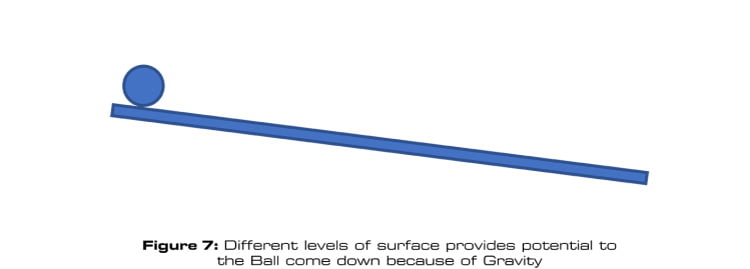
Of course, there are different types of potential, and then there could be different physical systems. In semiconductors, charges play a potential role. The basis of common semiconductors is silicon, but there must be potential and a closed loop to generate Electricity. Then, Silicon is dopped to Phosphorus and achieve 1 more Electron as an N-type semiconductor and negatively charged. On the other hand, Silicon is dopped to Boron, with 1 Electron less, as P type and positively charged, and then the loop components are ready. So you should know the idea of how solar panels work.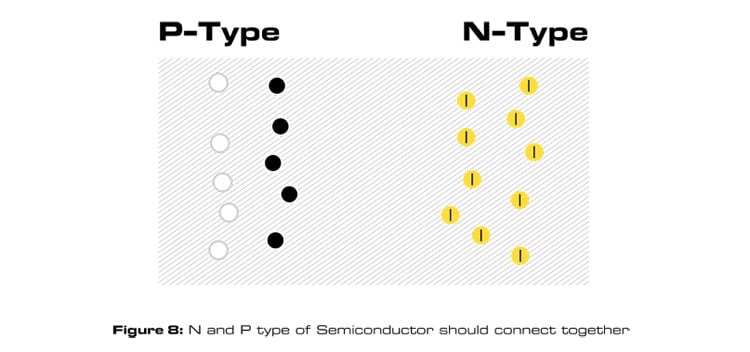
When N and P-type semiconductors connect, make Depletion region, and it is expected whole negative and positive charges neutralize each other. If it were correct, there would be no chance to make a closed loop and then an energy generator because they would be in short circuit.
Fortunately, nature is perfect. Negative and positive charges attract each other in the depletion zone, but not all of the charges have the possibility. Then, some negative and positive charges neutralize each other in the depletion zone and make a barrier that does not permit the rest of the charges to neutralize each other. So you should know how an idea of how does solar panels work.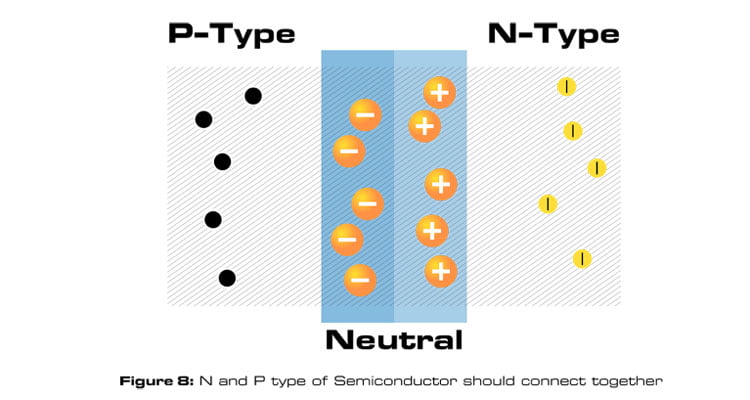
Photovoltaic under sun irradiance agitates negative and positive Charges that couple and are neutralized in the depletion region and push each of them back to their initial region, and if the sun irradiance (external Energy source) is removed, they will come back to each other in the depletion zone. But there is a lot of sun irradiance energy that we can use.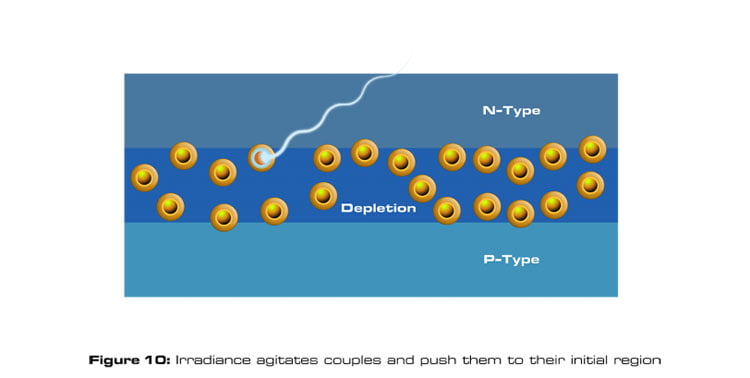
Agitated charges wait to find a way back to a neutral condition, and then there is potential. Now closed-loop time. If semiconductors connect from the other side, there will be a chance to neutralize each other and provide us with electricity.