
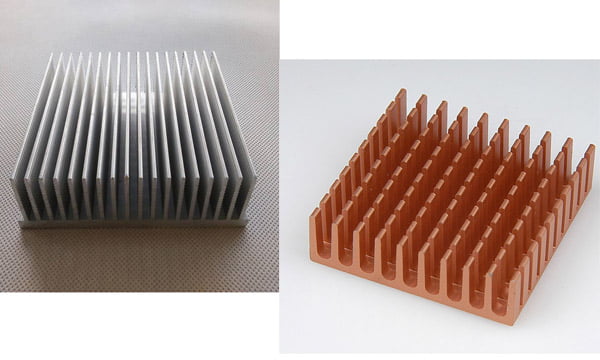
Today our topic is: “Are aluminum heatsinks better than copper heatsinks?
It is well known that electronic devices and machines generate a lot of heat. If the heat cannot dissipate rapidly, the machine will not work and cause a lot of trouble. So heatsinks play an important role in helping to cool them. The two most common metals used in the creation of heatsinks as electronic cooling solutions for electronic devices and machines are aluminum and copper.
You may be aware that aluminum is the most popular metal for heatsinks, and may think, “Are aluminum heatsinks better than copper heatsinks?”
Let’s look at a few different factors that come into play here, and I believe you will find the solution here (Are aluminum heatsinks better than copper heatsinks?).
Aluminum vs. Copper heatsinks: Let’s compare
Take a look at the following tables. In them, you can see the main factors that might influence the decision to use aluminum over copper for heatsinks, and would know the answer to “Are aluminum heatsinks better than copper heatsinks?”
Aluminum heatsinks vs. Copper heat sinks: Cost
As a responsible buyer of a company, the first issue you need to consider is cost. So we have a review of this matter first. Especially the material cost.
Take a look at this first table, and you’ll see that aluminum material is much cheaper than copper material. In fact, it comes in at about one-third the cost. That is a significant cost savings. One point for aluminum heat sinks.
| Material | Price in USD per Metric Ton (20 Oct, 2020) |
|---|---|
| Aluminum | $2,615.00 |
| Copper | $7,025.00 |
Aluminum heatsinks vs. Copper heat sinks: Heat conductivity
The next issue we need to check is the most important property of heat conductivity. As you can see in this table, copper heatsinks are more conductive than aluminum heatsinks. In fact, an aluminum heatsink only has 60% of the thermal conductivity that copper does. That’s one point for copper heatsinks.
| Metal | Thermal Conductivity [BTU/(hr·ft⋅°F)] |
|---|---|
| Aluminum | 136 |
| Copper | 231 |
Aluminum heatsinks vs. Copper heat sinks: Weight
If you look at the density of the two metals, you’ll notice that aluminum heatsink material has only about 30% of the density of copper. That means significant weight savings. One point for aluminum heatsinks!
| Metal | Density – ρ – (kg/m3) |
|---|---|
| Aluminum | 2712 |
| Copper | 8940 |
Aluminum heatsinks vs. Copper heat sinks: Surface color
The aluminum profiles are widely used in many occasions not only its material cost but also for its various surface color. We can do custom anodizing color for aluminum heatsinks after extrusion. While the copper heatsinks is always its nature color. One point for aluminum heatsinks.

Conclusion on: are aluminum heatsinks better then copper heat sinks?
We can conclude from the previous tables that “Are aluminum heatsinks better than copper heatsinks?” from the previous tables: aluminum heatsinks are popular for most occasions, but copper heatsink has its place.
As you can see, cost and weight savings are key factors in the popularity of aluminum for heatsinks.
Copper heatsinks are available on the market. They can be used in instances where higher heat conductivity outweighs the available weight savings.
Also, significant cost savings can be had by producing heatsinks through aluminum extrusion. Most heatsinks are produced this way.
Die casting and CNC machining can achieve more complex geometries. But, extruded aluminum heatsinks can meet the needs of most projects. If you’d like to learn more about our aluminum extrusion capabilities and purchase aluminum heatsinks, feel free to contact us.
How to choose the right aluminum heatsinks material
Now we have a clear idea of are aluminum heatsinks are better than copper heatsinks. The next step is to choose the right aluminum material for heat sinks.
Aluminum is the most common material for heat sinks. In particular, extruded aluminum heat sinks fit the needs of most projects.
The material is lightweight and has relatively good thermal conductivity.
Aluminum alloy 1050A has one of the higher thermal conductivity values af 229 W/m*k but is mechanically soft.
Aluminum alloys 6063 and 6060 are commonly used with thermal conductivity values of 166 and 201 W/m*k, respectively. The values depend on the temper of the alloy. T6 is better than T5.
Besides the question of “Are aluminum heatsinks better than copper heat sinks,” we will share other aluminum industry news later. Thanks for your eyes on our articles.
The Thermal Advantage: Why Aluminum Wins in Solar Infrastructure Optimization
When moving the aluminum vs. copper debate into large-scale renewable energy infrastructure through 2026, the thermal characteristics of metals take on a new level of financial importance. In photovoltaic (PV) systems, solar cell efficiency drastically degrades as operating temperatures rise. Therefore, managing thermal dissipation is critical for securing maximum energy yields.
While copper possesses higher raw thermal conductivity, aluminum remains the undisputed champion for utility-scale applications due to its supreme strength-to-weight ratio, cost efficiency, and corrosion resistance. Interestingly, this thermal debate also highlights the limitations of newly introduced alternative framing materials:
- Aluminum Framework vs. PU Composite Frame: The polymer-based PU composite frame is a thermal insulator (it traps heat). Under intense summer sunlight, panels using a PU composite frame can experience heat buildup, leading to higher cell temperatures and accelerated power degradation.
- The Structural Radiator Effect: Conversely, high-quality aluminum profiles, such as the standard heavy-duty 40mm solar frame or specialized double-glass solar frame designs, act as massive structural heat sinks. Aluminum’s excellent thermal dissipation capacity allows it to quickly conduct heat away from the silicon cell matrix and release it into the ambient air, maintaining cooler cell operations and optimizing the system’s overall LCOE (Levelized Cost of Energy).
Recent Posts
- Is aluminum good for solar panels?
- Non-metallic frame for solar modules is coming
- What are the applications of BIPV solar panels
- The next generation solar energy in 21st century
- First Solar signs definitive agreement to sell US development platform to Leeward
- Thailand to get world’s largest hydro-floating solar project
- What are 5 disadvantages of solar energy in 2026?
- What are 5 Advantages of Solar Energy? (2024-2026 Latest Updates)
- 5+ Free Solar Panel Frame Design Service
- What material is used in frame of solar panel?
- Who invented solar panels?
- How Do Solar Panels Work? (The Comprehensive 2026 Guide)