
What is the next generation solar energy in 21st century?
Harnessing the power of artificial intelligence and materials sciences for sustainability
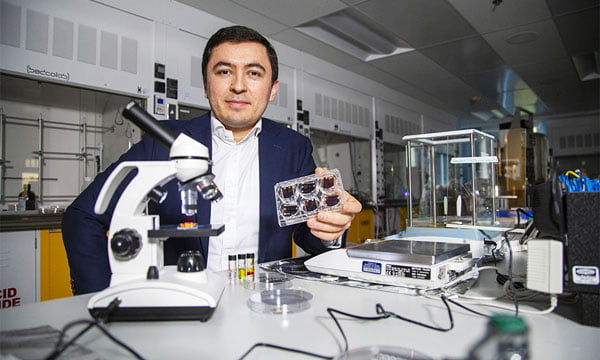
Growing up in Tajikistan, University of Victoria materials chemist Makhsud Saidaminov did much of his high school homework by candlelight. While electricity has since become much more reliable, during the winter in the early 2000s, power there was limited to eight hours a day.
“There was so much sunlight that could be captured,” says Saidaminov, Canada Research Chair in Advanced Functional Materials.
That awakened my ambition to contribute to solar energy.
—Makhsud Saidaminov, UVic materials chemist and Canada Research Chair
He went on to study chemical engineering, where he discovered the potential of perovskite, a family of materials often used as a semiconductor with a unique crystal structure that opens the door for a myriad of technological breakthroughs.
At UVic, Saidaminov is exploring the potential of perovskites as a key component in a new generation of solar cells that promises to be cheaper and more efficient than current solar technology.
“We know that we have to replace fossil fuels with renewable energy,” he says. “We will not stop until the world is getting 10 terawatts of energy from sunlight—about half of our current annual global energy consumption.”
Considering that silicon-based solar energy currently contributes to about two per cent of energy globally, this is a bold dream.
The wide-scale utilization of solar cells has been limited by setup costs and inefficient absorption of solar radiation. Compared to conventional silicon cells, perovskite is much more efficient at harvesting energy from the sun, and can be up to 200 times thinner. “We also found that despite being made at temperatures below 100 degrees Celsius, perovskite crystals offer competitive optoelectronic properties to silicon crystals typically made at over 1,000 degrees Celsius,” he adds. These soft conditions make it much easier to mass-produce solar cells.
Manufacturing perovskite cells requires lower startup costs and is less energy intensive to synthesize, opening up the production of solar power cells to the globe. “In many countries, there is just not enough water for hydroelectricity to be the dominant green energy source,” says Saidaminov. “And delivering energy is always a challenge. But the sun is available everywhere, and it’s free. So you can install solar cells on location and generate electricity locally.”
What makes his goal of making solar energy the dominant global power source even bolder is that he is aiming to make this new technology not just renewable, but also non-toxic. In order to build solar energy technologies that don’t rely on heavy metals, he is collaborating with Alex Voznyy’s research group at the University of Toronto. Together they are developing artificial intelligence that understands the principles of materials science, then asking the machine to predict and synthesize new materials with desirable properties.
While the first application of this AI will go towards the development of solar-harvesting materials, it could also be used to develop materials for a vast array of applications.
Saidaminov’s research is funded through his Canada Research Chair, the New Frontiers in Research Funds for Exploration, a Natural Sciences and Engineering Research Council of Canada Discovery grant, and grants from the private sector.
EdgeWise
More solar energy reaches the earth’s surface in a single hour than the world consumes in a year, demonstrating the potential of solar energy in meeting global needs.
The perovskite structure is based on a mineral that was discovered in the Ural Mountains in Russia in 1839, but its crystal structure can be relatively cheaply synthesized in a laboratory from a variety of different elements. This structure is already being used in ultrasound machines and memory chips.
Saidaminov’s research draws from a variety of disciplines including chemistry, physics and engineering. At UVic, he is cross-appointed in the Departments of Chemistry and Electrical and Computer Engineering.
In partnership with UVic medical physicist Magdalena Bazalova-Carter, Saidaminov is developing safer, cheaper, and more reliable X-ray photon sensors. By changing the material used to one that is more sensitive to electromagnetic radiation would require a lower radiation dose, reducing the health risks and increasing the frequency and reliability of diagnostic technologies for earlier detection of disease.
Through co-ops, awards and work studies, Saidaminov employs undergraduate researchers in discovery research and explorative work in his lab. “They bring a different approach and a certain amount of unpredictability,” he says. “For example what starts as a ‘mistake’ can end up changing the trajectory of our research, pulling us in an entirely unexpected direction.”
Anyway, the new solar panel will still in need of other solar materials, our aluminum solar panel frame will be the part of new generation solar panels.
Photo
The Material Revolution in Next-Generation Solar Infrastructure (2024-2026)
As we advance deeper into the 21st century, “Next-Generation Solar Energy” is no longer just about higher cell efficiency; it is heavily focused on the longevity, safety, and carbon footprint of the entire solar module structure. The period between 2024 and 2026 has witnessed a massive material revolution in solar framing technologies, bringing PU composite frames into the industry spotlight.
The most notable trend is the commercial mass production of polyurethane (PU) composite frames by global chemical giants and Tier-1 PV manufacturers. Initially piloted in 2016, these polymer-based PU composite frames officially secured TÜV Rheinland and TÜV SÜD certifications in May 2023, entering full-scale commercialization by 2024 to target ultra-lightweight and zero-PID (Potential Induced Degradation) utility projects.
However, despite the rising popularity of the PU composite frame, the future of next-generation solar utility infrastructure still heavily relies on advanced metal engineering. High-quality aluminum framing remains the absolute backbone of the industry, particularly when compared to the PU composite frame in high-end market segments:
The 35mm Solar Frame Standard vs. PU Composite Frame: As next-generation large-format wafers (such as 210mm and 182mm cells) become the industry standard, the structural stress on panels has multiplied. Premium 35mm aluminum frames offer the critical mechanical rigidity and wind-load resistance that a flexible PU composite frame cannot match over a 25-year lifespan.
Double Glass Solar Frame Technology vs. PU Composite Frame: With the rapid adoption of bifacial modules and BIPV (Building-Integrated Photovoltaics), double glass solar frames have become crucial. Aluminum’s unmatched non-combustible fire safety, mature structural sealing, and 100% recycling residual value ensure that it complies with strict global building codes and circular economy goals—areas where the polymer-based PU composite frame still faces strict architectural restrictions.
In conclusion, the 21st-century solar evolution is a balancing act between pioneering new materials like the PU composite frame and perfecting time-tested metals. For high-load, high-safety, and sustainable global solar farms, precision-engineered aluminum framework remains irreplaceable.
Recent Posts
- Is aluminum good for solar panels?
- Non-metallic frame for solar modules is coming
- What are the applications of BIPV solar panels
- The next generation solar energy in 21st century
- First Solar signs definitive agreement to sell US development platform to Leeward
- Thailand to get world’s largest hydro-floating solar project
- What are 5 disadvantages of solar energy in 2026?
- What are 5 Advantages of Solar Energy? (2024-2026 Latest Updates)
- 5+ Free Solar Panel Frame Design Service
- What material is used in frame of solar panel?
- Who invented solar panels?
- How Do Solar Panels Work? (The Comprehensive 2026 Guide)