Today we would like to talk about the solar panel thickness issue. Maybe you are not familiar with the term ” solar panel. I would like to tell you something about solar panels from WIKIPEDIA.
What is solar panel?
The term solar panel is used colloquially for a photovoltaic (PV) module.
A PV module is an assembly of photovoltaic cells mounted in a framework for installation. Photovoltaic cells use sunlight as a source of energy and generate direct current electricity. A collection of PV modules is called a PV Panel, and a system of Panels is an Array. Arrays of a photovoltaic system supply solar electricity to electrical equipment.
Photovoltaic modules use light energy (photons) from the Sun to generate electricity through the photovoltaic effect. Most modules use wafer-based crystalline silicon cells. The structural (load-carrying) member of a module can be either the top layer or the back layer. Cells must be protected from mechanical damage and moisture. Most modules are rigid; the cells are connected electrically in series, one to another, to the desired voltage, and then in parallel to increase amperage.
Solar panel component
As a solar panel frame manufacturer in China, we should know how a solar panel is made, cause our frame is one part of a solar module. First of all, let us check out the solar panel material breakdown pic to have an overall idea of solar panels.
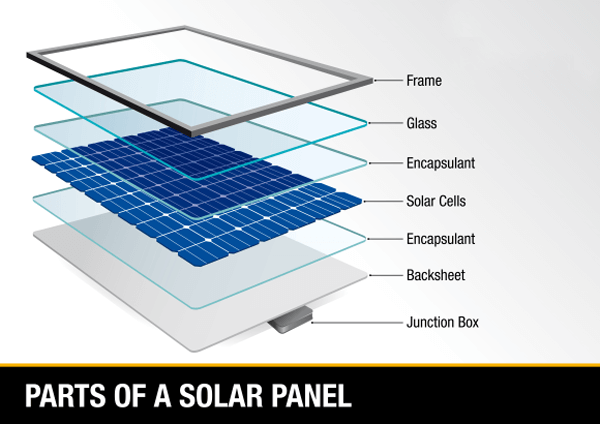
From this picture, we know that A solar PV module consists of solar cells, glass, EVA, backsheet, and frame. Among these components, the most important part is solar cells, and the most common material to create PV cells with is silicon crystals. Now we have a clear idea of solar panel material, and let us continue to talk about solar panel thickness.
What is the solar panel thickness?
The answer can be divided into two parts
- Thickness of solar laminate ( The actual solar panel)
- Thickness of solar panel with aluminium frame ( to strengthen, protect, and give ease of handling and installation)
For the thickness of solar laminate:
- The major thickness of the solar laminate is of solar glass, which is 3.2mm, in 90% of cases for 60-cell solar panels. There are other components like solar cells, encapsulant sheets (2 Nos), and the backsheet of the solar laminate. They are individually of different thickness, but when they are fused under high vacuum and high temperature, the thickness of the laminate can be anywhere between 4.2 mm and 4.6 mm.
- The major thickness of the solar laminate is of solar glass, which is 4.0mm for 72cell solar panels. There are other components like solar cells, encapsulant sheets (2 Nos), and backsheet of the solar laminate. They are individually of different thickness, but when they are fused under high vacuum and high temperature, the thickness of the laminate can be anywhere between 5.0 mm and 5.4 mm.
- 3. Now the new double glass /bifacial solar panel is becoming more and more popular because of its high power. But the solar glass is different from common solar panels; the glass thickness can be 2.0mm and 2.5 mm for choice. For the double-glass solar panels2.0mm glass thickness, laminated with other components like solar cells, encapsulant sheets (2 Nos), and backsheet, the total laminated thickness can be anywhere between 5.0 mm and 5.4 mm. For the double-glass solar panels2.5mm glass thickness, laminated with other components like solar cells, encapsulant sheets (2 Nos), and backsheet, the total laminated thickness can be anywhere between 6.0 mm and 6.4 mm.

For the thickness of solar panel with aluminium frame
For a solar panel with an aluminium frame, we can know that the laminate is then fixed in an aluminium frame whose thickness can be different according to the weight of the solar laminate it has to carry. The most popular sizes of aluminum solar panel frames can be concluded as follows:
1. 40mm solar frame (solar panel thickness),
2. 35mm solar frame (solar panel thickness),
3. 30mm solar frame (solar panel thickness),
5. BIPV solar frame,
Modern Solar Module Thickness and Structural Depth (2024-2026 Standards)
The technical definition of solar panel thickness between 2024 and 2026 involves a dual evolutionary track: the continuous thinning of the internal silicon wafer and the mandatory thickening of the outer structural protective frame. Driven by raw material cost optimization, manufacturing technology has successfully reduced internal silicon cell thickness from 175μm down to an ultra-thin 130μm–140μm profile.
However, because these thinner silicon cells are highly fragile and prone to internal micro-cracking, the dynamic mechanical loads on the module exterior dictate a much more rigid and robust structural framework:
The Evolution to the 35mm Solar Frame Baseline: In the early 2020s, smaller-format panels frequently utilized 30mm or even 25mm frame depths. Today, to support massive 182mm and 210mm wafer arrays, the premium 35mm solar frame has become the absolute global engineering baseline. Precision-extruded with reinforced internal cavity walls, a 35mm structural depth provides the exact section modulus required to prevent panel deflection and structural twisting under severe wind or snow pressures.
Dimensional Deflection in Non-Metal Alternatives: This thinner-cell revolution highlights the physical vulnerabilities of emerging alternative materials like the chemical-based PU composite frame. Because composite plastics possess a significantly lower elastic modulus compared to engineered aluminum alloys, a PU composite frame must often increase its overall profile thickness and cross-sectional depth to match the structural stiffness of metal, which adds unwanted dimensional complexities to standard racking clamps and tracker configurations.
Advanced Profiles for Double Glass and BIPV Systems: Next-generation bifacial layouts encapsulating dual layers of tempered glass require specialized structural channels. Deploying custom-extruded double glass solar frame profiles or high-precision architectural elements—such as the BIPV solar panel frame—ensures absolute moisture-proof sealing, micro-level structural tolerance, and strict compliance with international non-combustible building fire codes.
Conclusion on solar panel thickness
To sum up, for practical purposes, from the installer’s point of view, the thickness of the solar panel is the solar panel frame thickness. If you just wanna know the thickness of the lamination, I do believe you can find the answer in this article.
During the current these years, solar panel thickness is not only one size, but it can also be different because of the different sizes of solar panel frames. If your solar panel thickness is different and wanna a company to do OEM/ODM service for you. You can contact us. We will work with you well on your solar panels and project.


