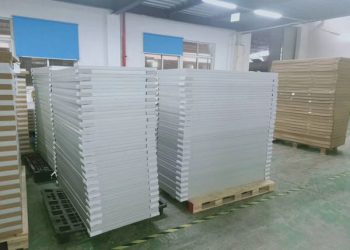
Do solar panels come in different sizes
Do solar panels come in different sizes?
The answer is an absolute yes. But what is the average solar panel size?
The average solar panel size is 77 × 39 inches or 65 × 39 inches, depending on whether they are for commercial or residential use. The size of an average solar panel is dependent on the number of cells encapsulated in it and the panel’s application. Understanding panel sizes (and weights) can be important from the point of view of selecting sizes based on roof space and the customer type (residential/commercial).
Solar Energy is arguably the most versatile of all energy sources. There are one-inch solar strips powering calculators, and there are hundreds of acres of a solar plant powering several towns. It can be used for any size of application. Naturally, it is neither easy nor wise to manufacture a single panel covering an entire rooftop or several acres of land. Thus, the need for the manufacturing of panels in different sizes. Do solar panels come in different sizes?
Difference between Residential and Commercial solar panels
Although the underlying technology and system structure are pretty much the same everywhere, the panel sizes may vary based on the available installation space. Residential systems, typically rooftop systems, usually require a few hundred square feet. They also require due consideration of the roof’s ability to carry weight.
As such, residential systems usually employ slightly smaller panels as compared to a commercial system. But exactly how big are solar panels that are employed for residential spaces? Usually these are 65 inches by 39 inches, or 5.4 feet by 3.25 feet. Speaking of commercial systems that have a comparatively much larger number of panels, the size is normally 77 by 39 inches, or 6.4 feet by 3.25 feet. The depth of a solar panel may be anywhere between 1 and 2 inches and depends mainly on the frame thickness.
You may have noticed that in both cases, the width remains the same. This factor is governed by the way solar cells are placed inside a panel. Generally, there are six columns of cells for both cases. For the smaller panels, there are 10 rows along the length, making 60 cells in one panel. For the larger one, there are 12 rows, making it 72 cells per panel. Do solar panels come in different sizes? It is obviously different for residential and commercial solar projects.

What is Residential and Commercial solar panels weight?
You might be wondering if your roof can support the weight of solar panels. Typically, 60-cell solar panels weigh around 40 pounds, while 72-cell solar panels weigh around 50 pounds. If you are in need of these items, you can buy these solar panels from us.
When going for rooftop systems, an important thing to consider is the weight of the solar panel. With all of the glass, frame, and laminating sheets contributing, the average weight of a solar panel is 40-50 pounds depending on size. Alternatively, it can also be said that panels weigh 2-4 pounds per square foot.
Besides the length and width, the word ‘size’ may mean different things to different people. Especially for people working in the solar industry, panel size usually refers to the maximum power a panel can generate. This is measured in Wp (Watt peak – Watts generated in standard or ideal conditions). For instance, a 77 x 39 panel may have a power rating of 320 Wp. Do solar panels come in different sizes? The answer is yes.
Do physical size have a relationship with power rating?
Though both are spoken in different numbers, the physical size does control the power rating. This depends totally on the power-generating capacity of individual cells. PV cells come in power ratings of 4 to 5 watts. A high-efficiency cell with a 5Wp rating used for a 72-cell panel will give us a 5*72 = 360Wp panel. The same cells for a smaller-sized (60-cell) panel would mean a 5*60 = 300Wp panel.
In a remarkably short duration, the energy produced per cell has been steeply increased. Solar cells are becoming more and more efficient. Consequently, as time progresses, solar panels will continue to get smaller for the power they generate, and they will require less space on roofs or the ground. Do solar panels come in different sizes? The answer is yes.
How many solar panels can fit on your roof
Residential rooftop solar systems are slowly becoming more and more popular. The technologies are advancing rapidly, including installation systems. With a host of available types, roof-mount systems are safer, and they don’t damage the roof in any way if done the right way.
In the design of any such system, an essential criterion is the available space. Besides, as far as energy consumption is concerned, a ‘one-size fits all’ approach never works. Thus, the other essential criterion is the energy consumption. Local solar panel installers in your vicinity can always calculate a system size and provide a quotation, but it certainly helps to know how to calculate the amount of solar panels you need yourself. This depends on two things – ‘how big is a solar panel?’ and ‘how much space does my roof have? Do solar panels come in different sizes? The answer is yes.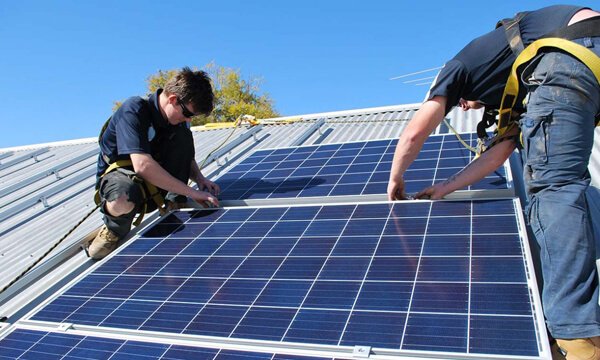
From the numbers in the previous sections, you can calculate the area of a single solar panel. Dividing your roof area by a single panel’s area will give you an approximate number of solar panels that can fit on your roof.
For example, a 60-cell panel will be about 17.5 square feet. Assuming you have a 1500 square feet roof, that would mean you can ideally install 1500/17.5 = 85 panels. However, there can be shaded areas on the roof where the panels won’t perform well and should be avoided.
As mentioned earlier, it is also important to know the required size in terms of energy consumption. The average system size in the United States is 6kW, and assuming a single panel is of 300Wp, one would need 6000/300 = 20 such panels for an average house.
Thus, we can see that area-wise the maximum number of panels ‘that can fit’ can be larger than the actual number of panels ‘required’ based on the energy utilized. Do solar panels come in different sizes? The answer is yes.
The 2024-2026 Dimensional Reality: The Rise of Large-Format Module Sizes
When analyzing whether solar panels come in different sizes, the answer in 2026 is no longer just about residential vs. commercial applications—it is dictated entirely by internal cell innovations. The global photovoltaic supply chain has fundamentally standardized around large-format M10 (182mm) and G12 (210mm) silicon wafers. This transition has caused the physical dimensions of mainstream modules to expand drastically compared to the early 2020s.
Today, standard sizes are segmented into distinct structural footprints:
Residential & Light Commercial Size: Typically utilizes 54-cell or 108-cell layouts (approx. 1722mm x 1134mm), keeping the weight manageable for standard rooftop installers.
Utility-Scale & Tracking Arrays: Utilizes massive 72-cell or 144-cell matrices (exceeding 2278mm x 1134mm up to 2384mm x 1303mm), designed to maximize power output per structural racking foundation.
However, as panel dimensions expand, the dynamic mechanical loads (wind uplift and snow pressure) on the panel surface multiply exponentially. Securing these varied sizes requires precise, highly engineered exterior framework depth:
The 35mm Solar Frame Baseline for Large Formats: While older, smaller panel sizes could safely rely on 30mm or 25mm profile depths, modern 182mm/210mm large-format panels strictly demand a heavy-duty 35mm solar frame. Precision-extruded with optimized alloy wall thickness, a 35mm profile depth provides the necessary section modulus to fully eliminate structural twisting and shield fragile silicon matrices from micro-cracking.
Specialized Sizing for Double Glass and Bifacial Units: Utility-scale projects increasingly deploy double-glass layouts to capture rear-side albedo reflection. To encapsulate two layers of tempered glass while maintaining tight micro-level dimensional tolerances, manufacturers utilize customized double glass solar frame architectures engineered to distribute loading stresses uniformly.
Infinite Customization for BIPV Project Formats: In modern urban building-integrated photovoltaics (BIPV), panels must adapt to bespoke architectural dimensions. Rather than using flexible but fatigue-prone chemical alternatives like the PU composite frame, advanced metal engineering thrives here. Precision interlocking rail matrices—such as the BIPV solar panel frame—allow custom-sized colored panels to integrate seamlessly into building envelopes while fulfilling international non-combustible safety and building drainage codes.
Conclusion (do solar panels come in different sizes)
Finally, we can summarize by saying that the size is controlled by the number of cells on the production side and by customer type on the installation side. It continues to get smaller, though, and the future will see high-efficiency panels that don’t eat up a lot of space. Do solar panels come in different sizes? The answer is yes.
Advantages of our solar panel
- High-Efficiency Polycrystalline Solar cells for higher module efficiency.
- High-quality, low-iron, toughened glass to ensure high light transmittance.
- Premium quality encapsulation material ensuring high-quality lamination.
- Robust, corrosion-resistant anodized aluminum frame.
- IP67 Junction boxes for long-term weather endurance.
- Manufacturing facilities are certified and operate as per ISO 9001:2015 Standards.
- Modules are certified as per IEC, TUV, CE & UL Standards.
- Warranty: 90% of the rated power is guaranteed for a period of 10 years and 80% for a period of 25 years.
Our solar panels certification


Our solar panels workshop and loading